5 min read · Jul 2026
AI vs. Manual Trip Planning: What Actually Saves You Time
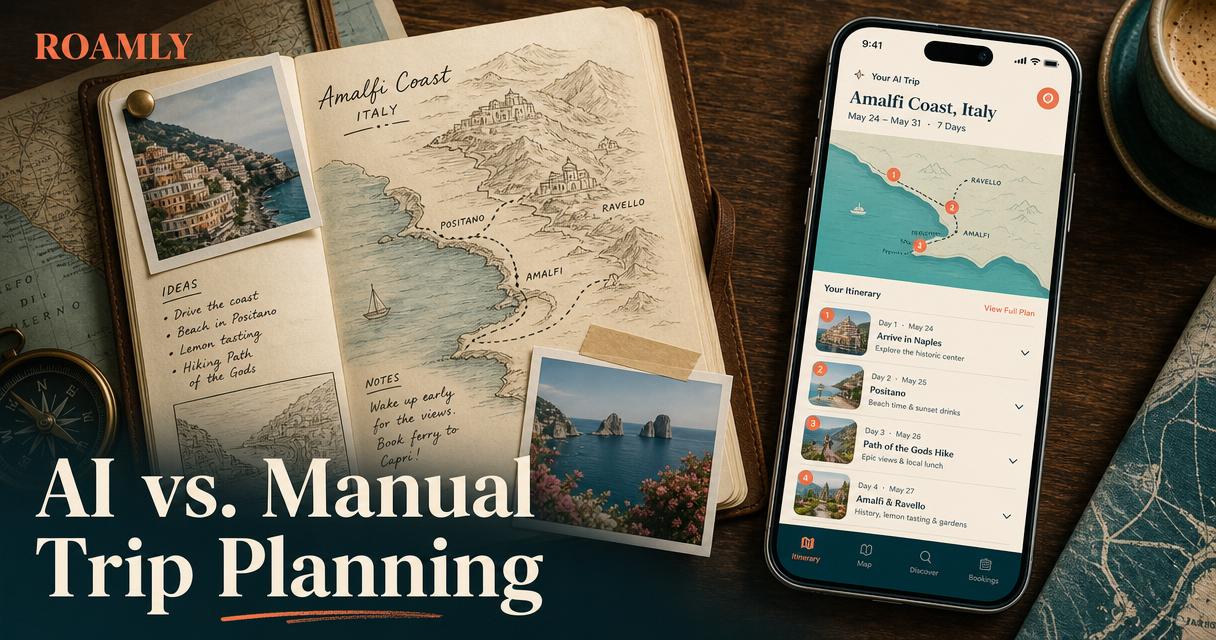
AI trip planners have quietly become good — but not for the reasons people expect. Here's an honest breakdown of what they do well, what they still botch, and how to combine AI and manual research.
Where AI wins
Drafting a plausible itinerary in seconds. Reshuffling a day when a flight moves. Estimating time between stops. Suggesting reasonable food, museums, and neighborhoods based on your interests.
This is the boring 60% of trip planning — and it's where AI saves the most hours.
Where humans still win
Local nuance: which side of a bridge to eat on, which market day is worth timing your trip around, which family-run guesthouse is worth the detour. AI can point you at these; it can't yet be them.
Recent, reliable info is also a weak spot — closures, transit strikes, and construction don't always make it into training data.
The hybrid workflow that wins
Let AI generate the frame — days, distances, headline stops. Then spend a focused hour cross-checking the top 3 experiences on the trip with a recent forum thread or a trusted travel writer. Feed the results back into the planner.
Roamly is designed for exactly this loop: draft with AI, edit anywhere, sync everywhere.
You don't have to choose between AI and manual planning. The travelers with the best trips do both — and let a tool like Roamly hold the whole thing together.
See Roamly pricingKeep reading
The Best AI Trip Planner for Europe in 2026
How to pick an AI trip planner that actually understands European trains, city passes, and shoulder-season quirks.
How to Plan a Road Trip with Friends (Without Losing Any)
A practical framework for splitting driving, budgets, and detours — and how AI can absorb the scheduling arguments.